



The Castle Park
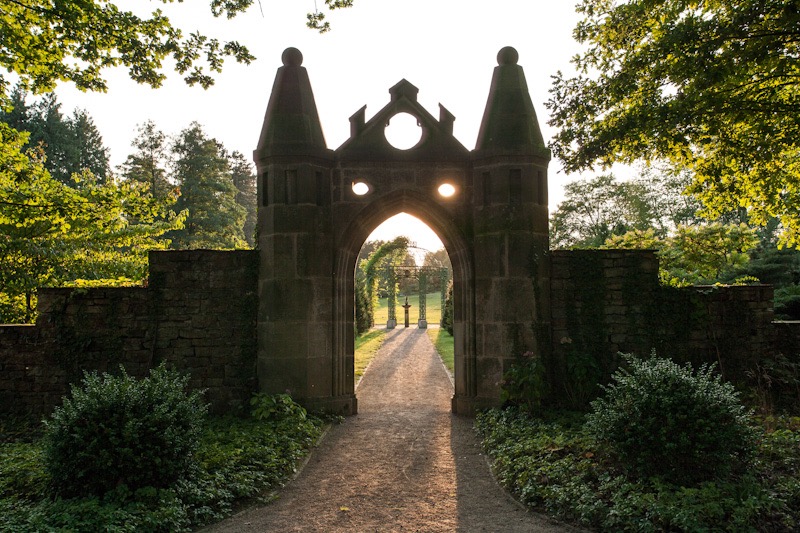
Stroll through or just explore and discover the wonders of the Castle Park, the multitude of plants, the variety of trees and walkways.
The unique parkland is a nature refuge, where one can simply relax.
With its many aspects, rare trees and plants, the park presents many surprises.
Even the Russian Tzar, Peter the Great, who visited the park and its Orangerie some 300 years ago, was astounded by its beauty and variety.
The grounds were carefully restored in 2003 based on historic plans from 1920. Today, visitors can once again experience the original paths, sightlines and garden structures. Since 2004, Castle Park has been open to guests of the hotel and restaurant.


History

For many centuries, the history of Schwöbber Castle and its gardens was closely tied to the Münchhausen family. While the castle still shows much of its original Renaissance character, the gardens have changed often over time.
In the 16th century, the palace’s ornamental garden was located northwest of the pond wing. It featured a water axis, which is still visible today as a narrow ditch surrounded by walls between the boathouse and the pinetum.
When Tsar Peter the Great visited in 1716 to see the famous pineapple crop and large orangery, this part of the garden was still designed as an ornamental garden with flowerbeds and fountains.
Around 1750, Otto II von Münchhausen redesigned the formal garden “in the English style.” His work later became known as one of the earliest English landscape gardens in Germany. Remnants can still be found in the wooded areas near the Ice Cellar, the Surprise viewpoint and the Pike Pond.


Plant Collection
The gardens originally supplied the castle with fruit and herbs, later expanding to include exotic citrus fruits and pineapples in the orangerie. By the 18th and 19th centuries, the focus had shifted to trees and shrubs. Many of these trees and shrubs still form the heart of the park today.
The current owner is a member of both the German Dendrological Society and the German Arboretum Society, demonstrating his commitment to preserving and expanding the plant collection.


A selection of unique plants and trees in the park
- Tulip tree (Liriodendron tulipifera)
- Kadsura tree (Cercidiphyllum japonicum)
- Ginko tree (Gingko biloba)
- Siver maple (Acer saccharinum)
- Eastern Hemlock (Tsuga canadensis)
- Elm (Ulmus carpinifolia suberosa)
- Christmas Berry (Photinia villosa)
- Alpine Laburnum (Laburnum alpinum)
- Black Tupelo (Nyssa sylvatica)
- Cut Leaf Beech (Fagus sylvatica laciniata)
- Dawn Redwood (Metasequoia glyptostroboides)
- Yezo Spruce (Picea yezoensis)
- White Oak (Quercus alba)
- Bald Cypress (Taxodium distichum)

Parkübersicht
